Cyber Resilience Act, the obligations already in force and what changed in November 2026
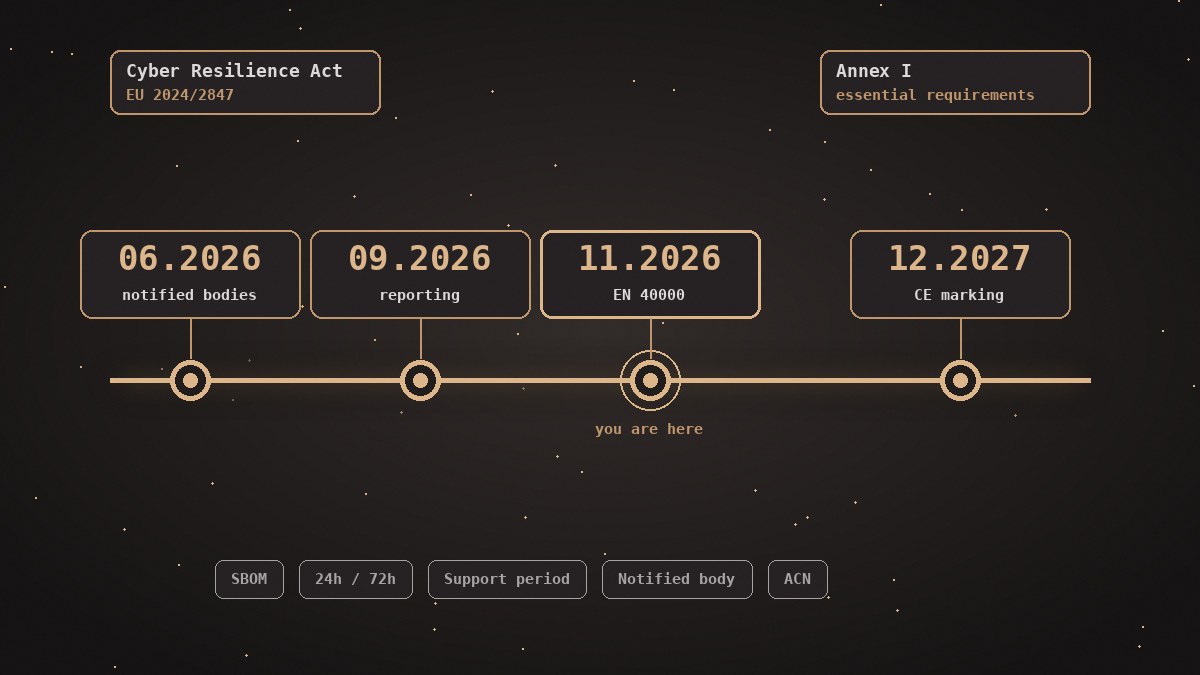
The Cyber Resilience Act (Regulation (EU) 2024/2847) has been in force since December 2024, but for many companies it only became tangible this autumn. Since 11 September 2026 manufacturers have had to report exploited vulnerabilities and severe incidents, and in recent weeks the first European standards, the Commission guidelines and the Italian decree entrusting market surveillance to the National Cybersecurity Agency have all arrived.
The regulation applies to anyone placing a product with digital elements on the European market, meaning hardware or software that connects, directly or indirectly, to a device or a network. That includes routers, cameras, smart locks, PLCs, operator panels, industrial gateways, operating systems, browsers and installed applications. In an industrial plant it covers almost everything above the cabling layer.
What changed in November 2026
| Date | What happened |
| 18–19 November | CEN and CENELEC publish the first two standards of the EN 40000 series, the common vocabulary (EN 40000-1-1) and the cybersecurity principles with lifecycle risk management (EN 40000-1-2) |
| Mid-November | The Commission guidelines on the application of the CRA, whose content was approved in July, reach final publication |
| 10 November | The Commission gives standardisation bodies three more months for part of the standards, including all product-specific ones |
| 4 November | ENISA upgrades the single reporting platform and the Assigned Representatives manual to version 1.3 |
| 15 October | In Germany the Bundestag passes the implementing act, entrusting enforcement to the BSI |
| 2 October | The Italian Council of Ministers gives preliminary approval to the draft legislative decree, which then goes to Parliament |
The standards are here, the presumption of conformity is not yet
The publication of the first EN 40000 standards is good news, because it finally gives product teams a common reference for terms, risk analysis and lifecycle. It needs to be read carefully, though. A manufacturer benefits from the presumption of conformity under Article 27 only when applying harmonised standards whose reference is published in the Official Journal of the EU, and so far no CRA standard has been.
More than thirty documents are still being drafted, including EN 40000-1-3 on secure development and vulnerability handling and the vertical standards for categories such as firewalls, routers, operating systems and microcontrollers. With the extension granted on 10 November, some of them will arrive in 2027, so anyone waiting for the final standard before starting may end up with only a few months before December 2027.
What the Commission guidelines clarify
The guidelines are not binding, but they explain how the Commission reads the regulation, and market surveillance authorities will take them into account.
- Software installed on the user’s device is a product with digital elements, whereas a website or web application used only through the browser generally is not, unless it is remote data processing necessary for a product to work, for example the cloud managing a smart lock or a remote management platform.
- A substantial modification is assessed on risk, not size. Security updates are normally not one, while a new feature that changes the attack surface may be, and in that case the product must be treated as newly placed on the market.
- The five-year support period is the reference value, not an absolute minimum, and can be shorter only if the product’s expected use is shorter. The end-of-support date must be disclosed at the time of purchase.
- Open source software developed outside a commercial activity remains largely out of scope, while whoever integrates it into a product they sell is responsible for it like any other component.
- Whether a product is important or critical depends on its core functionality, according to the technical descriptions in Implementing Regulation (EU) 2025/2392.
Italy entrusts market surveillance to ACN
The draft legislative decree approved on 2 October, implementing the delegation in Law 36 of 2026, designates the National Cybersecurity Agency (ACN) as notifying authority for conformity assessment bodies and as market surveillance authority for the CRA requirements, with possible support from the Guardia di Finanza. For the financial sector, Banca d’Italia, Consob and IVASS remain competent.
The text also provides for a regulatory sandbox run by ACN and a consultation channel with the Ministry of Enterprises, which will be especially useful for small and medium-sized companies. The decree is still before Parliament, so details may change, but the direction is clear and the counterpart will be the same body that already handles NIS2 and CSIRT Italia.
What is mandatory today
The Article 14 reporting obligation also applies to products placed on the market before December 2027, including those sold years ago and still in use. A manufacturer who becomes aware of an actively exploited vulnerability or a severe incident must submit, through the ENISA platform and to the competent CSIRT, an early warning within 24 hours, a notification within 72 hours and a final report within 14 days of a fix becoming available for vulnerabilities, or within one month for incidents. It must also inform users and indicate the measures they should take.
Since 11 June 2026 the rules on notified bodies have also applied, and those bodies are starting to obtain accreditation. For products that will need one, it is worth booking early, because assessment capacity will be limited and demand will peak in 2027.
What arrives on 11 December 2027
From that date no product with digital elements may be placed on the European market without meeting the essential requirements of Annex I and having technical documentation, an EU declaration of conformity and the CE marking.
- Security by design and by default, meaning no known exploitable vulnerabilities at the time of sale, a secure initial configuration, no common default passwords and the ability to reset to the original state.
- Protection of data and access, with appropriate authentication, encryption, integrity of data and firmware, data minimisation and a reduced attack surface.
- Availability and resilience, including the ability to keep essential functions running during an attack and to limit its impact on other devices.
- Logging of relevant security events, with an option for the user to disable it.
- Vulnerability handling, with an SBOM covering at least the top-level dependencies, a coordinated disclosure policy, a public point of contact and free security updates kept separate, where possible, from functional ones.
The assessment route depends on the product class.
| Class | Examples | Conformity assessment |
| Default products | Most devices and software | Self-assessment by the manufacturer |
| Important class I | Routers, identity and access management systems, VPNs, browsers, operating systems, SIEM, smart home products with security functions | Self-assessment only when applying harmonised standards, otherwise a notified body |
| Important class II | Firewalls, intrusion detection and prevention systems, hypervisors, tamper-resistant microprocessors and microcontrollers | Notified body |
| Critical | Smart cards, secure elements, smart meter gateways, hardware devices with security boxes | Notified body or European certification, where required |
As long as no harmonised standard is cited in the Official Journal, class I products will also have to go through a notified body. That is one more reason not to wait.
Not only manufacturers
Importers must check that the non-EU manufacturer has carried out the conformity assessment, that technical documentation and CE marking exist and that the product shows the contact details for reporting vulnerabilities. Distributors must check marking and documents and stop sales when they know a product is not compliant.
Buyers have a role too. A company subject to NIS2 must manage supplier risk, and the CRA finally gives it concrete criteria to put into tenders, such as support duration, SBOM, vulnerability handling policy and a point of contact for reports. Anyone who integrates and resells machines or plants with digital components should also ask whether they are themselves a manufacturer under the CRA, and the answer is often yes.
Penalties
Failing to meet the essential requirements and reporting obligations can cost up to 15 million euros or 2.5% of worldwide turnover, whichever is higher. For other obligations the ceiling is 10 million or 2%, and for incorrect or misleading information supplied to authorities 5 million or 1%. Authorities can also order products to be withdrawn or recalled, which for many companies is more damaging than the fine.
What to do in the coming months
- Map the portfolio, stating for each product whether it falls under the CRA, in which class and which support period it can sustain.
- Make reporting operational, with accounts on the ENISA platform, at least two representatives, a runbook and an escalation chain that holds up within 24 hours even at night and on holidays.
- Set up vulnerability handling, with SBOMs generated at every release, dependency monitoring, a coordinated disclosure policy and a public channel for researchers.
- Run a gap analysis against Annex I, starting with the best-selling products and those in the important classes, and using EN 40000-1-2 as the basis for risk analysis.
- Plan the conformity assessment, contacting a notified body early where one is needed.
- Review contracts and suppliers, asking suppliers of components, libraries and firmware for SBOMs, fix times and support duration.
How we can help
We support manufacturers of machines, devices and software along the CRA path, from portfolio classification and Annex I gap analysis to SBOMs, risk analysis according to IEC 62443 and product security testing. Our SOC can monitor vulnerability sources and support the PSIRT with 24 and 72 hour reports. For buyers, we help translate the CRA into supply requirements consistent with NIS2.
To go further, read our article on the ENISA reporting platform, the one on the 2027 Machinery Regulation and the page on CRA and Machinery Regulation. If you want to understand where your products stand, get in touch.
Sources
- Regulation (EU) 2024/2847, Cyber Resilience Act
- European Commission, First European standard published to support the Cyber Resilience Act, 19 November 2026
- Cybersecurity360, Cyber Resilience Act, the first EU standards, 20 November 2026
- Agenda Digitale, Cyber Resilience Act, first EU standards, 20 November 2026
- European Commission, Guidelines on the application of the Cyber Resilience Act, C(2026) 5252
- Implementing Regulation (EU) 2025/2392, technical descriptions of important and critical products
- Cybersecurity360, CRA, the Italian decree entrusts market surveillance to ACN, October 2026
- ENISA, Single Reporting Platform, Assigned Representatives manual v1.3, 4 November 2026