DLP and Shadow AI: protecting data when employees use artificial intelligence
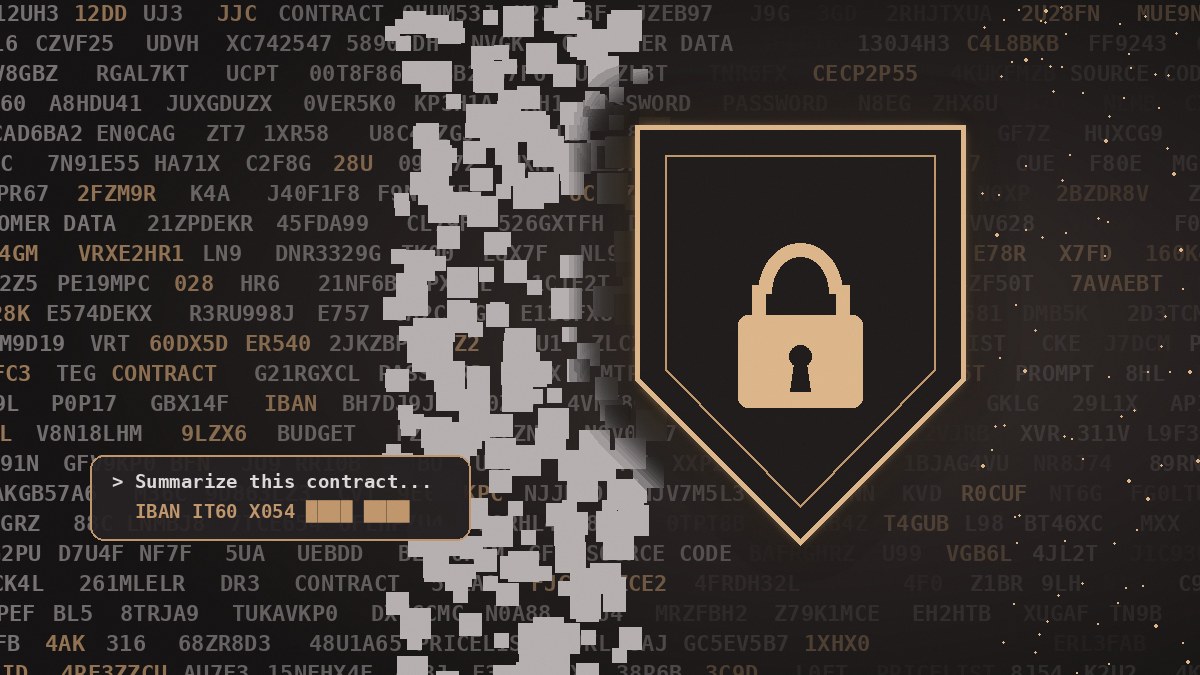
Every company holds information that is worth as much as its plants and equipment, if not more: customer records, contracts, price lists, designs, source code, financial data. For years the question was how to stop someone from breaking in to take it. Today the question has changed: how do you stop it from walking out, even when a well-meaning employee is the one carrying it?
Why DLP is back at the centre
DLP (Data Loss Prevention) is the set of technologies and processes that recognise sensitive data, follow its path, and apply rules when someone tries to move, copy or share it without authorisation.
The perimeter that once protected data no longer exists. People work from home and from different devices, use cloud applications, share links, and chat on collaboration platforms. Every file has dozens of ways out of the company, and most of them do not pass through a firewall that can read their content.
Regulatory pressure adds to this. The GDPR provides for fines of up to €20 million or 4% of annual worldwide turnover, while NIS2 introduces risk management and incident notification obligations, with fines of up to €10 million or 2% of turnover for essential entities. Not knowing where your data is, and who is using it, is no longer acceptable.
The new leak channel: artificial intelligence
Generative AI tools have entered companies through the front door of productivity: writing an email, summarising a contract, fixing a function, analysing a spreadsheet. They are convenient, fast, and one browser tab away.
The catch is that to get an answer you have to hand over the content. A salesperson pastes an offer with confidential pricing, an engineer uploads a piece of proprietary code, an accountant asks for a summary of a file full of IBANs and personal data. Nobody is stealing anything, yet that information is now outside the company’s control, on a third-party service whose terms of use few people have read. As early as 2023, several large companies restricted or banned these tools after incidents of exactly this kind.
Shadow AI: you can’t protect what you can’t see
Shadow AI is the use of AI applications that are unauthorised and unknown to IT: personal accounts, browser extensions, assistants built into other software, new services appearing every week. It is the evolution of the old Shadow IT, with one important difference: the data is not just stored elsewhere, it can be processed, retained and, in some cases, used to train models.
A blanket ban rarely works. People find a way around it, often on a personal phone, and the company loses all visibility. A two-step approach is more effective: discover which tools are being used, then govern their use with clear rules.
What a modern DLP must be able to do
A DLP built for these scenarios goes well beyond keyword matching. The capabilities that make the difference are:
- Content and context awareness: not only what is in the file, but who is using it, from where, and toward which destination.
- Endpoint coverage: control happens where the data is touched, on the computer, even off the corporate network and off the VPN.
- Many channels, one place: email, browser, cloud storage, USB drives, printing, messaging applications.
- Data classification, manual and automatic, to tell a public document from a confidential one.
- Behavioural analysis, to spot anomalies such as bulk downloads or unusual transfers, typical of a malicious insider or a compromised account.
- Graduated responses: allow, warn the user, ask for a justification, block.
- Evidence for investigations: complete logs of who did what, and when.
Intercepting what is entered into AI
The step change today is extending those same rules to the moment a user writes a prompt or uploads a file to an AI service. In practice this means being able to:
- Detect the AI applications in use, sanctioned or not, and rate them by risk level.
- Inspect the content of prompts, pasted text and attachments before they reach the service.
- Apply differentiated policies: for example, allow the approved corporate tool, allow a public service only for non-sensitive content, block the submission of source code or personal data.
- Warn and coach the user at the exact moment they are about to make a mistake, with a clear message rather than a sterile block.
- Log the events, to understand which departments rely on these tools most and where safe alternatives are needed.
The aim is to reconcile two needs that seem to conflict: not slowing down people who work better thanks to AI, and not giving away the company’s information assets.
Compliance: a bonus, not the main reason
A well-configured DLP helps demonstrate that adequate technical measures are in place under the GDPR, supports the risk management obligations of NIS2 and ISO 27001, and fits into the AI governance expected under the EU AI Act. But the real reason is simpler: data is the business.
How to start without paralysing the company
- Map your critical data: what it is, where it lives, who uses it.
- Observe before you block: start in detection-only mode for a few weeks and analyse what really happens, including which AI apps are used.
- Define an AI usage policy, written and understandable: what can be entered, in which tools, and what never can.
- Roll out rules gradually: warnings first, then blocks for the most serious cases.
- Train your people: technology reduces risk, awareness prevents it.
- Connect DLP to the SOC, because a data leak event must be correlated with everything else to tell whether it is a mistake or an attack.
In short
Artificial intelligence is a huge opportunity, but it has opened a data exit that traditional defences cannot see. A modern DLP, able to read what is typed into prompts as well, lets you keep innovating without losing control of the information the business depends on.
If you want to understand where your organisation stands, get in touch: we can start with an assessment of your data flows and AI usage.