ENISA and the supply chain, the risk that comes through suppliers
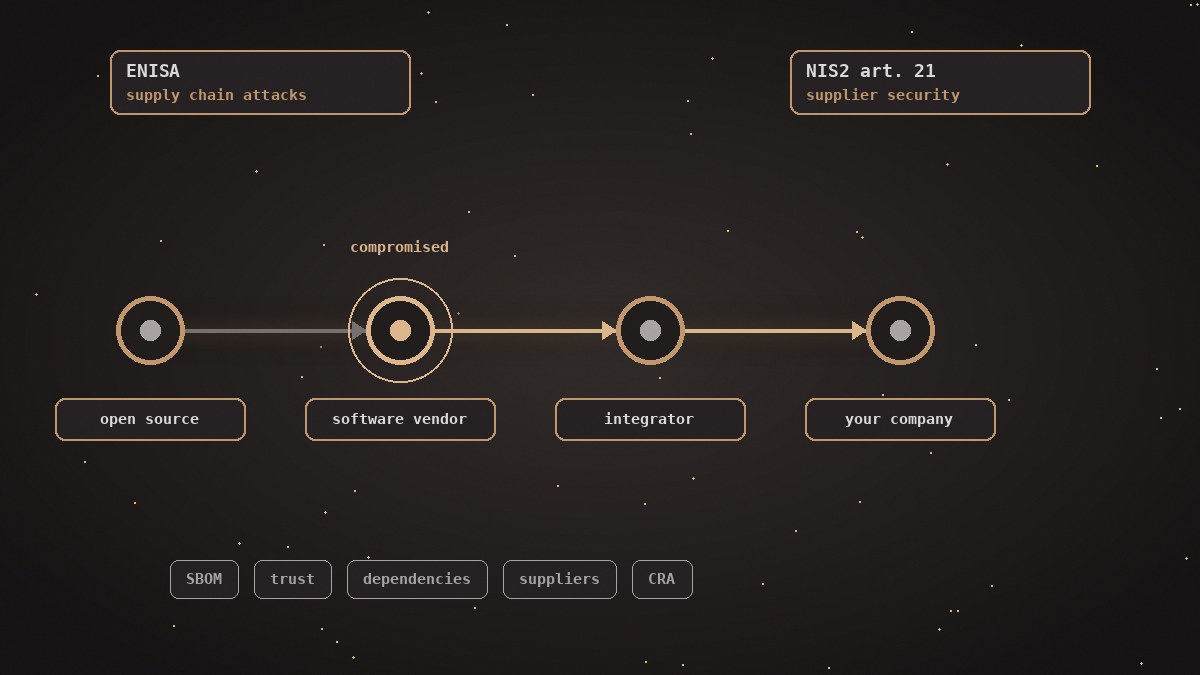
When an attacker cannot get into a company, they often get in through whoever works with it. A software vendor, an integrator, an open source library or a technician connecting remotely becomes the shortest path. This is why ENISA, the European Union Agency for Cybersecurity, has paid particular attention to the supply chain for years, and why European legislation now treats it as a compliance matter and not just good practice.
What ENISA has said about the supply chain
In July 2021 ENISA published the report Threat Landscape for Supply Chain Attacks, which analysed 24 attacks between January 2020 and mid 2021. Its figures are still useful for understanding the nature of the problem.
- In almost two attacks out of three (62%) the attackers exploited the trust the customer placed in the supplier.
- In 66% of cases the supplier did not know, or did not report, how it had been compromised, while fewer than 9% of the affected customers could not explain the attack method. Those upstream in the chain often cannot see what is happening to them.
- About half of the attacks were attributed to known APT groups, while 42% had no attribution.
- The main targets were source code and customer data, that is, what makes it possible to hit many other organisations in a cascade.
The report also forecast roughly a fourfold increase in this type of attack in 2021 compared with the previous year. An important point is that a supply chain attack always hits two levels, the supplier and the customer, and that protecting only your own perimeter is not enough.
Attention has not faded. The ENISA Threat Landscape 2025, which examines 4,875 incidents between July 2024 and June 2025, reports that criminal groups increasingly look for critical points of dependency, such as the digital supply chain, to get the maximum effect from a single attack. The techniques described include the compromise of software and open source repositories, malicious browser extensions and, growing, attacks on the artificial intelligence supply chain. Among the sectors where the report finds these techniques are telecommunications, logistics and manufacturing.
Why the supply chain is so hard to defend
- Trust is the vector. An update signed by the supplier or an authorised remote access is not treated as suspicious, so it passes many controls.
- Visibility is partial. Often you do not know which third-party components are inside a product, or in which versions.
- The chain is long. The supplier has suppliers of its own, and the risk travels through every level.
- The effect is systemic. A single compromised supplier can hit hundreds of customers at the same time.
- In OT the problem weighs more. Plants depend on manufacturers, integrators and maintainers who access remotely and who replace components with very long life cycles.
What European legislation requires
The NIS2 Directive, in Article 21, includes supply chain security among the minimum risk management measures, including the aspects concerning relationships with direct suppliers. Essential and important entities must therefore assess the vulnerabilities and security practices of those who serve them.
Article 22 goes beyond the single entity and provides for coordinated risk assessments of critical supply chains, carried out by the NIS Cooperation Group together with the Commission and ENISA. In February 2026 the Cooperation Group adopted a European toolbox for ICT supply chain security, which recommends, among other things, assessing critical suppliers and reducing dependence on high-risk ones. ENISA’s 2024 report on the state of cybersecurity in the Union had already called for strengthening these assessments and building a horizontal European framework.
The Cyber Resilience Act also touches the subject, because it requires manufacturers to exercise due diligence on the third-party components included in their products, to keep a software bill of materials (SBOM) and, from 11 September 2026, to report actively exploited vulnerabilities through the platform run by ENISA. In practice the supply chain enters the product, the contract and the reporting procedures.
How to manage supplier risk in practice
- Map your suppliers and rank them by criticality, that is, by how much a failure or compromise on their side would affect services, data and production.
- Know what you buy, by asking for the list of software components (SBOM) and for information on vulnerability management and the support period.
- Put requirements in contracts, such as incident notification times, the right to audit, minimum security levels and rules for subcontractors.
- Control supplier access, limiting it to what is needed, for the time needed, with strong authentication and session recording, especially towards OT environments.
- Verify updates before installing them, in a test environment where possible, and check the integrity of packages and open source dependencies.
- Segment the network so that a compromised supplier cannot reach everything behind it.
- Monitor the behaviour of third-party systems and accounts, because a legitimate access used in an abnormal way is exactly the signal to catch.
- Plan an exit, with alternatives and procedures to activate if a critical supplier suffers an incident or stops operating.
A concrete example
A machine builder has its own supplier of supervision software, which in turn uses an open source library. If the library is compromised, the update arrives signed in the builder’s system and from there to its customers on the factory floor. Those who had a bill of components know at once whether they are exposed, those who segmented the network limit the damage, and those with a contract that sets clear notification times get information in hours and not in weeks.
In summary
ENISA describes the supply chain as a growing risk because attackers have understood that hitting a single link reaches many targets. The answer is not to stop trusting suppliers, but to verify that trust, with inventories, contracts, access control and monitoring. It is work that NIS2 and the CRA now make mandatory and that is best set up before it is needed.
To go deeper into the obligations see the pages on NIS2 and on CRA and the Machinery Regulation, and the article on the 2027 Machinery Regulation. If you want to assess the risks of your suppliers or control their access, contact us and we can support you with our SOC.